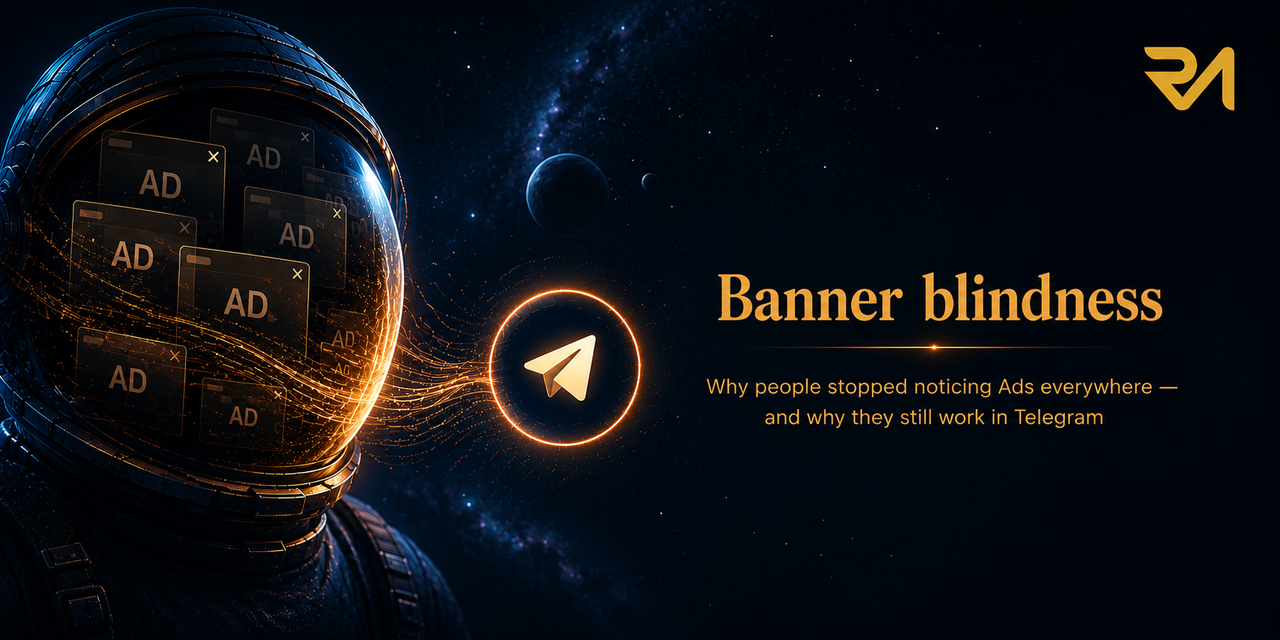
Banner blindness. Why people stopped noticing Ads everywhere — and why they still work in Telegram
What banner blindness is, why our brain learned
to not see ads — and why Telegram is still the
exception you'd be crazy not to use
You see hundreds of ads every day. How many do you remember? Probably none. And it's not because the ads are bad. Your brain has simply learned to not see them.
This has a name — banner blindness. Over the years, while Google and Facebook filled our screens with banners, users built an automatic filter: anything that looks like an ad slips past your attention before you even notice it's there.
But there's one place where this filter doesn't work yet. In this article we break down what banner blindness is, why it kills the effectiveness of regular ads — and why Telegram right now gives you what most channels have already lost: real, live attention.
What banner blindness is
The term appeared back in 1998 — it was coined by researchers Benway and Lane after a series of tests. They found something strange: even if you make a banner big, bright, and useful, people still don't see it. They came to a website with a clear task in mind — and the brain simply cut out of view everything that didn't help with that task.
Later this was confirmed by eye-tracking studies, which follow where the eyes move. The heatmaps show it clearly: the gaze goes around the "ad zones" — the top banner, the right column, anything usually linked with ads. And it's not a conscious choice. It's a reflex.
Here's what years of this "training" led to:
- The average CTR of banner ads dropped to 0.05–0.1% — meaning literally one person out of a thousand clicks.
- About 8% of users make 85% of all clicks on banners. The rest don't click at all.
- More than 40% of users worldwide use ad blockers — and among younger audiences the share is even higher.
In simple words: a regular banner today pays for views that no one sees.
Why the brain switches ads off
Banner blindness isn't laziness or bad intent from the user. It's just how our attention works. Here's what triggers it:
Habit. The brain saves effort and filters out anything predictable and irrelevant. If you've seen a banner in the right corner a thousand times and it was never useful — on the thousand-and-first time you literally won't notice it.
Predictable placement. Ads are almost always in the same spots: the header, the sidebar, a pop-up window. The user knows in advance where ads "live" — and has learned not to look there.
"This isn't what I came for." A person opens a page for the content. An ad feels like an obstacle between them and their goal — so attention goes around it automatically.
"Sales" signals. Loud colors, "buy now," pushy calls to action. These markers switch on distrust and the urge to scroll past faster, not interest.
That's exactly why native formats — the ones that look like part of the content, not like an ad — work far better than banners. By industry estimates, their CTR is 4–10 times higher. They get past the filter because they don't look like what the brain is used to ignoring.
The Telegram paradox. Why ads still work here?
Now for the interesting part. Banner blindness isn't a law of nature — it's a learned reflex. It forms where there's a lot of advertising and it's been around a long time. And it doesn't have time to form where advertising is young.
Telegram is exactly that case.
Telegram's official ad platform, Telegram Ads, appeared only at the end of 2021 and really opened up to a wider range of advertisers in 2022–2023. For comparison: Google has run ads since 2000, Facebook since about 2007. A gap of 15–20 years. Telegram users simply haven't had time to build the same blindness — ads here still stand out instead of blending into the noise.
And that's not the only reason. Telegram has no "ad zones" you can learn to skip with your eyes:
- The ad appears inside the feed of a channel the person chose and reads by their own choice — meaning in an environment they trust.
- The format is as native as it gets: short text with a "Sponsored" label, no banner noise, no pop-ups.
- People read channels on purpose, not scrolling an endless feed half on autopilot like on social media. Higher engagement means more attention to everything in the feed.
The numbers back this up. CTR on Telegram Ads usually stays around 2–6% depending on the topic — that's 2–3 times higher than the average for Meta or Google. And native formats inside Mini Apps give even more.
Here's the paradox: less ad "infrastructure" = more attention. Where advertising hasn't yet become background noise, every ad gets a fair chance to be noticed.
But the window won't last forever. So let's talk about how not to burn the advantage
There's an important catch here. Blindness is a process, not a fixed state. If tomorrow Telegram gets flooded with aggressive, irrelevant ads, users will build the same filter they have for Google banners. The whole advantage disappears.
So you have to work with this window carefully. A few rules worth building into your strategy from the start:
- Get in now, before the reflex forms. The cheapest and most attentive audience is the one that isn't tired of ads in your niche yet. In a year it might be a different story.
- Don't burn the trust. Native, relevant, no spam. Every aggressive ad brings closer the moment the audience learns not to see you. You're either building up trust or spending it.
- The format decides everything. Telegram has no picture to save you and no loud banners — it has text. One clear message, no fluff, no visual noise. If your 160 characters don't hook — the money goes nowhere.
- Measure actions, not views. Clicks are nice, but subscriptions, bot starts, and sales matter more. Attention with no result is just expensive traffic.
- Don't overload with frequency. Even the best creative gets boring. You have to let the audience "rest" — otherwise you're training banner blindness for your own brand with your own hands.
The most important thing you need to understand: there's a pattern that repeats with every shift in the market. Early players first look like odd ones, then like the obvious choice, and later like the ones who arrived too late. That's how it was for those who built on Shopify in 2014, or moved into Facebook while ads there still cost pennies. With advertising in Telegram right now — it's the same moment: the window when "smart and early" hasn't yet turned into "obvious and late." Banner blindness will come to Telegram one day too. The only question is whether you'll gather that attention before it does — or after.
Ready to get in while Telegram still sees your ads?
We work exactly at this point — where marketing meets the audience's attention. We don't just pour in traffic: we pick the channels, build native creatives for the Telegram format, and count real actions, not views.
RA AGENCY